





Adrian Per – The Filmmaker’s Academy is a complete cinematic filmmaking program for content creators, videographers, and aspiring filmmakers who want to transform ordinary videos into intentional, professional-looking visual stories.
Instead of teaching filmmaking as a collection of camera settings, transitions, and editing tricks, Adrian Per focuses on the creative decisions that make footage feel cinematic. You’ll learn how filmmakers use composition, framing, camera movement, lighting, lenses, sound design, pacing, and storytelling to guide attention and create emotion.
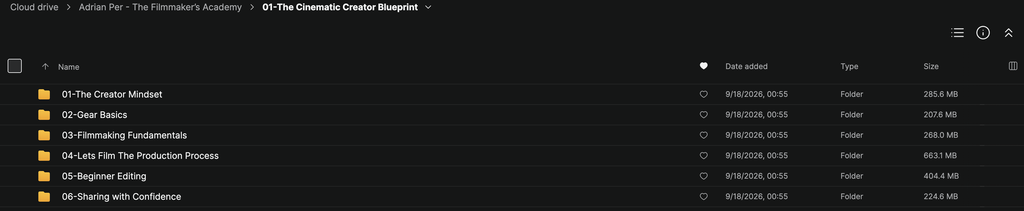
The training combines The Filmmaker’s Academy with The Cinematic Creator Blueprint, giving you a structured learning path from essential filmmaking principles to more advanced cinematic techniques.
Whether you create YouTube videos, Instagram Reels, short films, branded content, commercial projects, or social media videos, the goal is to help you stop simply recording content and start thinking and creating like a filmmaker.
What’s Included in The Filmmaker’s Academy?
The program covers the complete creative filmmaking workflow, including:
- The Filmmaker’s Academy
- The Cinematic Creator Blueprint
- Visual storytelling principles
- Composition and professional framing
- Cinematic camera movement
- Shot sequencing and narrative flow
- Lens choice and focal length
- Cinematic lighting techniques
- Camera-angle psychology
- Vertical video composition
- Sound design and audio layering
- Editing rhythm and pacing
- The Filmmaker’s Journal
- Filmmaking Templates Pack
- Sound Design Starter Pack
- Process & Practice Footage
- Project Planning Template
- Bonus learning resources
The course is structured to help you understand not only how to execute filmmaking techniques, but also why and when to use them.
Adrian Per – The Filmmaker’s Academy Course Breakdown
Module 1 – Creator to Filmmaker Mindset
The first module establishes one of the most important foundations of the entire program: learning to approach your work as a filmmaker rather than simply as a content creator.
Instead of capturing random beautiful shots and trying to connect them afterward, you’ll begin thinking about intention, emotion, story, and purpose before pressing record.
Chapter 1 – Setting the Stage
Understand how the program works, what you’ll be creating, and how to get the most from each lesson.
Chapter 2 – What It Means to Think Like a Filmmaker
Explore the difference between simply producing content and deliberately constructing a visual story.
You’ll begin considering what every creative decision communicates to the viewer.
Chapter 3 – The Power of Intentionality in Every Shot
Learn why strong filmmaking is rarely accidental.
Framing, lighting, movement, lenses, sound, and editing should all contribute to what you want the audience to experience.
Chapter 4 – Project Setup
Create a practical project that allows you to implement what you learn throughout the training.
Rather than consuming the course passively, you can immediately apply the concepts to your own filmmaking.
Module 2 – Visual Storytelling for Solo Shooters
Strong filmmaking isn’t simply about producing attractive footage.
Your images should communicate.
This module explores how filmmakers transform individual shots into visual sequences that tell stories, establish environments, communicate relationships, and create emotion.
How Filmmakers Approach Story Through Visuals
Learn how to think visually instead of relying exclusively on dialogue, captions, or narration.
You’ll explore how images themselves can communicate information to the audience.
Intermediate Composition & Framing Principles
Move beyond basic composition rules and learn how framing can deliberately control where viewers look and what they feel.
You’ll develop a stronger understanding of:
- Subject placement
- Visual balance
- Depth
- Negative space
- Leading elements
- Perspective
- Environmental context
- Visual hierarchy
Camera Movement to Drive Emotion
Camera movement shouldn’t exist simply because movement looks impressive.
You’ll learn how different movements can support different emotional and narrative objectives.
The goal is to make movement motivated by the story.
Planning Shot Sequences for Narrative Flow
Learn how to think beyond individual shots.
You’ll discover how to plan sequences where wide shots, medium shots, close-ups, details, and movement work together naturally.
This can make both filming and editing considerably more intentional.
Lens Choice & Focal Length for Mood
Lens selection affects much more than how much of the scene fits into your frame.
You’ll learn how focal length influences:
- Perspective
- Subject separation
- Environmental context
- Intimacy
- Compression
- Perceived distance
- Emotional tone
Instead of automatically choosing your favorite lens, you’ll begin selecting focal lengths according to the story.
Module 3 – Cinematic Shooting Techniques
This section explores what actually makes an image feel cinematic.
Rather than relying on expensive cameras, presets, LUTs, or complicated equipment, Adrian breaks cinematic imagery into practical creative principles.
What Does “Cinematic” Actually Mean?
Develop a clearer understanding of the elements that contribute to cinematic imagery and why simply adding black bars or color grading doesn’t automatically make footage cinematic.
Cinematic Lighting With One Light
Learn how to create stronger images without requiring an enormous lighting setup.
Adrian demonstrates how a single light source can be positioned and controlled to create:
- Depth
- Contrast
- Shape
- Mood
- Separation
- Dramatic shadows
This is particularly useful for solo filmmakers and creators working with limited equipment.
The Psychology of Camera Angles
Where you place the camera changes how the viewer interprets a subject.
You’ll explore how camera height, distance, perspective, and framing can communicate feelings such as:
- Confidence
- Vulnerability
- Power
- Isolation
- Intimacy
- Tension
- Scale
Instead of choosing camera angles randomly, you’ll learn to use them as storytelling decisions.
Framing for Vertical Video
Cinematic filmmaking isn’t limited to traditional horizontal formats.
The course also explores intentional composition for Instagram Reels, TikTok, YouTube Shorts, and other vertical video formats.
You’ll learn Adrian’s approach to the Center Eye Rule and Renaissance-inspired composition principles to create stronger vertical frames.
Module 4 – Sound & Edit Rhythm
Visuals capture attention, but sound and editing can dramatically change how those visuals feel.
This module teaches you to approach post-production as part of the storytelling process.
Sound as a Cinematic Storytelling Tool
Discover how sound can establish atmosphere, increase tension, create anticipation, reinforce movement, and make relatively simple footage feel more immersive.
Adrian’s Sound Formula
You’ll study Adrian’s approach:
Riser → Climax → Silence
The framework demonstrates how building sound and strategically removing it can create contrast and emotional impact.
Pacing & Rhythm – Editing to Evoke Emotion
Editing isn’t simply about cutting clips together.
You’ll learn how timing influences the viewer’s emotional response.
The training explores concepts such as:
- Shot duration
- Visual rhythm
- Music synchronization
- Building tension
- Releasing tension
- Strategic silence
- Pacing transitions
- Emotional timing
Building Immersive Sound Layers
Learn how multiple audio elements can be combined to give your scenes greater depth.
Rather than relying entirely on music, you’ll explore the role of environmental sounds, impacts, risers, textures, and subtle audio details.
Applying Sound Design in Real Time
See the concepts applied practically so you can understand how raw footage evolves during the editing and sound-design process.
Module 5 – Preparing for Advanced Filmmaking
Once you understand individual filmmaking techniques, the next challenge is bringing them together consistently.
The final module focuses on developing your craft beyond individual tutorials.
What Separates Intermediate From Pro-Level Work
Explore the creative details that can distinguish competent filmmaking from more polished and intentional work.
Building a Sustainable Filmmaker Practice
Improvement comes from consistent creative practice rather than endlessly consuming tutorials.
You’ll learn how to continue developing your filmmaking abilities while avoiding an unsustainable creative process.
What You’re Now Ready For
Identify how the skills you’ve developed can be applied to more ambitious projects and advanced filmmaking challenges.
Final Reflection – Where You Go From Here
Evaluate your development and establish the next stage of your filmmaking journey.
The objective is to leave the Academy with a framework you can continue applying long after completing the lessons.
The Cinematic Creator Blueprint
Enrollment in The Filmmaker’s Academy also includes The Cinematic Creator Blueprint.
The Blueprint complements the Academy by strengthening the foundations behind cinematic content creation.
Together, the two resources provide a progression from:
Content Creator → Cinematic Creator → Filmmaker
Instead of jumping directly into advanced techniques without understanding the fundamentals, you can build your filmmaking knowledge progressively.
The Filmmaker’s Journal
The included Filmmaker’s Journal provides a structured space for reflecting on what you’re learning and applying those concepts to your own projects.
Use it to document:
- Creative concepts
- Shot ideas
- Story development
- Visual references
- Filmmaking experiments
- Lessons from completed projects
- Areas that need improvement
- Future creative goals
This encourages active learning instead of simply watching another collection of video tutorials.
Filmmaking Templates Pack
Planning is a major part of professional filmmaking.
The included Filmmaking Templates Pack helps streamline pre-production with reusable resources covering areas such as:
- Shot lists
- Lighting guides
- Story structures
- Pacing maps
- Production planning
These resources can help you organize ideas before filming and reduce unnecessary improvisation during production.
Sound Design Starter Pack
Sound is one of the easiest filmmaking elements for new creators to underestimate.
The included Sound Design Starter Pack provides practical assets for experimenting with the techniques taught in the program.
The collection includes elements such as:
- Risers
- Hits
- Ambient textures
- Cinematic sound elements
You can use these resources to practice layering audio and creating more immersive edits.
Process & Practice Footage
The Academy also gives you an opportunity to study actual filmmaking workflows rather than seeing only finished results.
You’ll get an inside look at Adrian’s process and can work with practice footage to experiment with your own creative decisions.
This gives you a chance to practice:
- Shot selection
- Sequencing
- Pacing
- Music
- Sound design
- Story structure
- Editing rhythm
Working with real footage can help bridge the gap between understanding filmmaking concepts and actually applying them.
Project Planning Template
Great filmmaking often begins long before the camera starts recording.
The included planning resources help organize the complete creative process:
Concept → Story → Shot List → Production → Edit → Final Film
You’ll learn how to transform scattered creative ideas into a clearer production plan and build stronger narrative flow before entering the editing stage.
What You’ll Learn in The Filmmaker’s Academy
By working through Adrian Per – The Filmmaker’s Academy, you’ll learn how to:
- Think like a filmmaker instead of simply recording content
- Create shots with clear creative intention
- Improve composition and framing
- Communicate emotion visually
- Plan cinematic shot sequences
- Use camera movement purposefully
- Choose lenses according to story and mood
- Create cinematic lighting with minimal equipment
- Understand how camera angles affect perception
- Produce stronger vertical videos
- Create narrative flow between shots
- Use sound as a storytelling tool
- Build immersive audio layers
- Improve editing rhythm and pacing
- Use silence and contrast effectively
- Plan projects before production
- Develop a more consistent creative process
- Progress toward more advanced filmmaking
Who Is Adrian Per’s The Filmmaker’s Academy For?
The program is designed for creators who already make videos or want to develop a stronger filmmaking foundation.
It can be particularly relevant for:
- Aspiring filmmakers
- Content creators
- Videographers
- YouTubers
- Instagram creators
- TikTok creators
- Solo shooters
- Freelance videographers
- Brand content creators
- Social media filmmakers
- Creative entrepreneurs
- Intermediate creators wanting more cinematic results
Because many techniques are designed with solo creators in mind, you don’t necessarily need a large production crew to start applying what you learn.
Why The Filmmaker’s Academy Stands Out
One of the biggest differences between The Filmmaker’s Academy and basic video-production tutorials is its emphasis on creative intention.
The objective isn’t simply to teach you another transition, camera movement, or editing effect.
Instead, you learn to ask:
Why should the camera move?
Why should this scene be framed this way?
Why should this lens be used?
Why should the edit become faster or slower?
Why should the sound disappear at this moment?
Those decisions are what transform technical video production into storytelling.
By understanding the reasoning behind filmmaking techniques, you can adapt the principles to different cameras, projects, platforms, and creative styles rather than depending on a fixed collection of presets.
From Content Creator to Filmmaker
Adrian Per – The Filmmaker’s Academy offers a structured filmmaking education for creators who want their videos to become more deliberate, emotional, polished, and cinematic.
From visual storytelling and composition to camera movement, lighting, lens selection, vertical framing, sound design, editing rhythm, and project planning, the course covers the creative decisions behind the entire filmmaking process.
Combined with The Cinematic Creator Blueprint, Filmmaker’s Journal, Filmmaking Templates Pack, Sound Design Starter Pack, practice footage, and project-planning resources, the program provides both education and practical tools for developing your filmmaking craft.
If you’ve reached the point where simply creating “good-looking content” is no longer enough, The Filmmaker’s Academy is designed to help you understand the principles behind creating films that communicate a story and make viewers feel something.





Reviews
There are no reviews yet.