




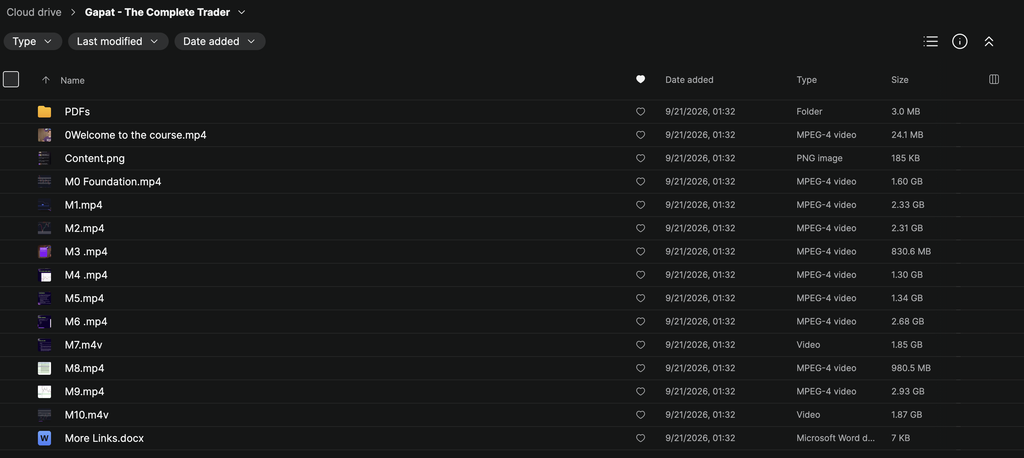
Gapat – The Complete Trader is a structured trading mentorship designed to help developing traders build a complete decision-making process around market structure, trade selection, entries, targets, execution, risk, psychology, timing, and performance review.
The program brings the full 10-week mentorship into a recorded format, allowing students to work through the methodology at their own pace. Rather than focusing on isolated setups or indicators, The Complete Trader develops a broader trading framework: understanding market conditions, identifying higher-quality opportunities, executing according to predefined rules, and reviewing performance systematically.
From foundational concepts such as support, resistance, and R-multiples to advanced topics including market timing, intermarket triggers, TICK/AD indicators, emotional frameworks, professional journaling, and personalized trade blueprints, the curriculum is built around developing a more structured approach to trading.
What Is Gapat – The Complete Trader?
The Complete Trader is designed around an important distinction: learning a trading setup is not the same as developing a complete trading process.
A trader still needs to determine:
- Where the important market levels are
- Whether a potential setup meets predefined criteria
- Where an entry makes sense
- Where risk should be defined
- How targets should be selected
- When market conditions support the trade
- How to think about uncertainty
- How to execute consistently
- How to review previous decisions
- How to develop a repeatable trading plan
The mentorship approaches these elements as parts of one interconnected system.
The objective is not to predict every market movement. Instead, the training emphasizes developing a framework for making decisions under uncertainty and evaluating those decisions over a meaningful sample of trades.
What’s Included in The Complete Trader?
The program contains the recorded 10-week mentorship, organized into foundational and advanced trading topics.
Training covers areas such as:
- Support and resistance
- R and risk/reward concepts
- Trade setup evaluation
- A+ setup scoring
- Entry techniques
- Target selection
- Scenario management
- Probabilistic thinking
- Trading visualization
- Market timing
- Emotional management frameworks
- Intermarket analysis
- Market triggers
- TICK indicator concepts
- Advance/Decline data
- Professional trade journaling
- Performance review
- Personalized trading plans
- Trade blueprint development
- Supporting PDF resources
The progression moves from understanding individual trading concepts toward combining them into a personal execution framework.
Gapat – The Complete Trader Course Breakdown
Module 0 – Trading Foundations
The mentorship begins with the foundational concepts needed for the rest of the trading framework.
Rather than immediately searching for entries, students first develop a clearer understanding of market levels, risk, and trade structure.
Support and Resistance
Learn how to identify areas where market participants may react and how these levels can provide context for potential trading scenarios.
The goal isn’t simply to draw more lines on a chart. It’s to understand which areas may actually matter when constructing a trade idea.
Understanding R
Risk becomes easier to evaluate when performance is expressed consistently.
The concept of R provides a standardized way to compare trades based on the amount initially risked.
For example, rather than evaluating performance only in dollars, a trader can evaluate outcomes relative to predefined risk.
This can provide a clearer framework for:
- Comparing trades
- Reviewing performance
- Evaluating reward relative to risk
- Maintaining consistent risk parameters
- Analyzing a strategy over time
Module 1 – Expectations & A+ Setups
Once the foundations are established, the course moves into trade selection.
One of the challenges traders face is distinguishing a valid opportunity from a mediocre setup that happens to look attractive in the moment.
Setting Realistic Trading Expectations
Trading involves uncertainty.
This section helps establish expectations around the process rather than treating individual outcomes as proof that a trading decision was good or bad.
The broader objective is to think in terms of repeated execution and probabilities.
Scoring A+ Setups
Students learn how to evaluate potential opportunities against a defined set of criteria.
Instead of treating every setup equally, a structured scoring process can help identify situations that align more closely with the trading framework.
This encourages a shift from:
“Can I take this trade?”
toward:
“Does this trade meet my predefined criteria?”
That distinction can make trade selection more systematic.
Module 2 – Entries, Scenarios & Targets
Finding an interesting market area is only the beginning.
You still need a plan for what happens next.
This module focuses on converting market analysis into an executable trading scenario.
Scenario Planning
Markets can behave in multiple ways.
Rather than relying entirely on one prediction, scenario planning helps traders define how they will respond if different conditions develop.
A structured process might involve:
Market Context → Key Level → Expected Scenario → Confirmation → Entry → Risk → Target
The objective is to make important decisions before the pressure of live execution affects judgment.
Trade Entries
Learn how entries fit within the broader setup rather than viewing entry precision as the entire strategy.
The mentorship explores how context and confirmation can influence execution decisions.
Target Selection
A complete trade requires more than an entry.
Students also learn to think systematically about where profits may be taken based on the structure and logic of the original trade idea.
This creates a more complete framework:
Setup → Entry → Risk → Management → Target
Module 3 – Execution Mindset
Technical knowledge alone doesn’t guarantee consistent execution.
A trader can understand a strategy and still struggle to follow it when real money, uncertainty, fear, or excitement enters the equation.
This module focuses on the mental side of implementing a trading process.
Probabilistic Thinking
Individual trades are uncertain.
A well-planned trade can lose, while a poorly planned trade can occasionally win.
Understanding this distinction is fundamental.
Probabilistic thinking encourages traders to judge their process across a series of trades rather than emotionally reacting to every individual outcome.
This helps separate:
Trade Quality from Trade Outcome.
Visualization
Visualization can be used to mentally rehearse different trading situations before encountering them live.
That may include scenarios such as:
- Taking a planned loss
- Missing a trade
- Waiting for confirmation
- Avoiding an impulsive entry
- Following a predefined target
- Handling consecutive losing trades
- Executing a valid setup without hesitation
The objective is to make disciplined responses more familiar before they are required in real time.
Advanced Training – Weeks 4–10
After establishing the core framework, The Complete Trader moves into more advanced elements of market analysis and performance development.
Market Timing
Not every market environment offers the same conditions.
The advanced curriculum explores how timing can influence the quality and context of trading opportunities.
Students develop a deeper understanding of when their trading framework may be more relevant and when conditions may warrant greater selectivity.
Emotional Frameworks
Trading psychology is treated as something that can be observed and managed systematically.
Rather than simply telling traders to “control their emotions,” the mentorship explores frameworks for recognizing behavioral patterns that can interfere with execution.
Common challenges traders may need to monitor include:
- FOMO
- Revenge trading
- Hesitation
- Overtrading
- Impulsive entries
- Moving stops without a predefined reason
- Abandoning targets
- Increasing risk emotionally
- Trading outside the plan
The objective is to identify these patterns through structured review rather than relying entirely on willpower.
Intermarket Triggers
Markets don’t always operate independently.
The advanced curriculum introduces intermarket triggers and teaches students to observe relationships between different market information when evaluating a trading scenario.
This adds another layer of context to technical analysis and can help students develop a broader view of market behavior.
TICK and Advance/Decline Indicators
The mentorship also explores market-internal tools such as TICK and Advance/Decline (AD) data.
Rather than treating indicators as automatic buy or sell signals, these tools can be studied as additional information about underlying market participation and short-term conditions.
Students learn how such information can fit into a broader decision-making framework instead of replacing price action or risk management.
Professional Trading Journal
A journal becomes significantly more valuable when it records more than profit and loss.
The Complete Trader explores a more comprehensive approach to documenting trading activity.
A useful trading journal can capture:
- Setup type
- Market context
- Entry
- Stop
- Target
- Initial risk
- R result
- Setup quality
- Execution quality
- Screenshots
- Emotional state
- Rule adherence
- Mistakes
- Observations
- Lessons learned
Over time, this information can help reveal patterns that aren’t obvious from account balance alone.
Building Your Personalized Trade Blueprint
The later stages of the mentorship bring the individual concepts together.
Instead of finishing with disconnected notes about support, resistance, entries, indicators, and psychology, students work toward developing a personalized trading blueprint.
The blueprint can define areas such as:
Market → Context → Setup → Confirmation → Entry → Risk → Management → Target → Journal → Review
This creates a repeatable process that can be tested and refined over time.
What You’ll Learn in The Complete Trader
Through the full training, students can develop their understanding of:
- Support and resistance
- Risk and R-multiples
- Trade setup qualification
- A+ setup scoring
- Scenario planning
- Entry selection
- Target selection
- Risk management concepts
- Probabilistic thinking
- Trading visualization
- Market timing
- Emotional awareness
- Execution discipline
- Intermarket analysis
- TICK and AD indicators
- Professional trade journaling
- Performance review
- Trading-plan development
- Personalized trade blueprints
More importantly, these concepts are designed to work together as parts of one trading process.
From Random Trades to a Structured Trading Process
A central theme of Gapat – The Complete Trader is replacing reactive trading with predefined decision-making.
Instead of:
See movement → Feel urgency → Enter → Decide what to do afterward
the course encourages a more structured process:
Analyze → Build Scenario → Qualify Setup → Define Entry → Define Risk → Define Target → Execute → Journal → Review
This doesn’t eliminate uncertainty from trading. It creates a framework for managing decisions within that uncertainty.
Who Is The Complete Trader For?
The program may be particularly relevant for:
- Developing traders
- Active traders
- Day traders
- Technical traders
- Traders learning market structure
- Traders struggling with inconsistent execution
- Traders wanting clearer entry and target rules
- Traders interested in market internals
- Traders working on psychology and discipline
- Traders wanting a professional journaling process
- Traders developing their own trading plan
It may be especially useful for students who already understand basic charting but want to organize their knowledge into a more complete process.
Why Gapat – The Complete Trader Stands Out
The course doesn’t focus exclusively on finding another entry signal.
Instead, the curriculum connects technical analysis, execution, risk, market timing, psychology, market internals, journaling, and performance review.
That creates a progression from:
Market Knowledge → Setup Selection → Trade Planning → Execution → Review → Refinement
This broader approach matters because long-term trading development involves much more than identifying where to click buy or sell.
Final Thoughts
Gapat – The Complete Trader packages a complete 10-week trading mentorship into a structured recorded program covering the foundations and more advanced aspects of building a repeatable trading process.
Students move through support and resistance, R-based risk concepts, A+ setup scoring, scenarios, entries, targets, probabilistic thinking, visualization, market timing, emotional frameworks, intermarket triggers, TICK/AD indicators, professional journaling, and personalized trade-blueprint development.
Rather than promising a shortcut to profitable trading, the program focuses on the processes traders can actually work on: analysis, preparation, risk definition, execution, documentation, and continuous review.






Reviews
There are no reviews yet.