




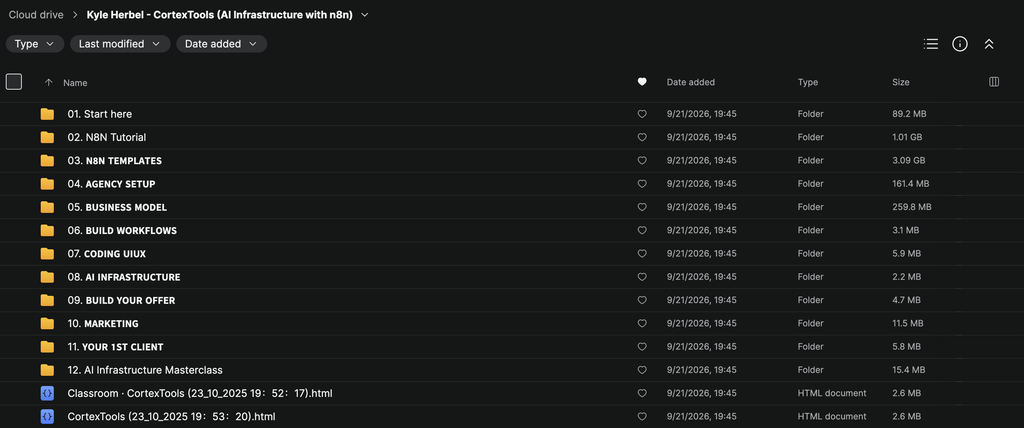
CortexTools by Kyle Herbel is a practical AI automation and agency-building program designed to teach entrepreneurs, freelancers, automation specialists, and agency owners how to build AI infrastructure with n8n, create reusable workflows, and turn those technical capabilities into services businesses can actually use.
Instead of stopping at simple ChatGPT prompts or isolated automations, CortexTools focuses on creating complete systems. The training covers n8n fundamentals, workflow templates, AI infrastructure, agency setup, business models, workflow development, coding and UI/UX, offer creation, and marketing.
The goal is to help you understand both sides of AI automation: how to build reliable systems and how to package those systems into valuable business solutions.
What Is CortexTools by Kyle Herbel?
Modern businesses often use dozens of disconnected applications for sales, marketing, customer support, lead management, reporting, and internal operations.
Automation platforms such as n8n can connect those tools and allow information to move automatically between them.
CortexTools teaches you how to approach these integrations as infrastructure rather than one-off automations.
You’ll learn how to think in terms of:
Trigger → Data → Logic → AI → Action → Output
This framework can be applied to many different automation projects, from simple administrative workflows to more sophisticated AI-powered business systems.
What’s Included in CortexTools?
The program includes training and resources covering:
- n8n automation fundamentals
- Practical n8n tutorials
- Ready-to-use n8n templates
- AI workflow development
- Automation agency setup
- AI automation business models
- Workflow architecture
- Coding fundamentals
- UI/UX principles
- AI infrastructure
- Offer development
- Marketing systems
- Implementation resources
Rather than learning each subject independently, the curriculum is structured around building the technical and commercial skills required to create useful automation solutions.
CortexTools Course Breakdown
Module 1 – Getting Started
The opening section introduces the CortexTools ecosystem and prepares you for the training ahead.
You’ll establish the foundations needed to understand how n8n workflows, AI tools, integrations, and business systems fit together.
This stage is particularly useful for students who have experimented with AI but haven’t yet built structured automation systems.
Module 2 – n8n Tutorial
The n8n Tutorial provides the technical foundation for the program.
You’ll learn how workflows are structured and how different applications, APIs, databases, and AI services can communicate through automated processes.
Topics can include concepts such as:
- Workflow triggers
- Nodes
- Actions
- Data mapping
- Conditional logic
- Webhooks
- API connections
- Data transformation
- Workflow testing
- Error handling
- AI integrations
The objective is to move beyond copying automations and develop an understanding of how workflows actually work.
Module 3 – n8n Templates
CortexTools includes an extensive n8n Templates library.
Instead of building every automation from an empty canvas, templates can provide working structures that you can study, customize, and adapt to different projects.
This section helps you understand how real automation systems are assembled while reducing repetitive setup work.
Templates can also become starting points for client implementations, internal business processes, or your own experiments.
The key skill is not simply importing a template. It’s learning how to modify workflows according to the requirements of a specific business.
Module 4 – Agency Setup
Knowing how to build automations is only one part of creating an AI automation business.
The Agency Setup section focuses on turning technical knowledge into an organized service operation.
You’ll learn how to think about the systems required to manage an automation agency, including:
- Service structure
- Client onboarding
- Project organization
- Delivery processes
- Automation management
- Documentation
- Client communication
- Operational workflows
This can help bridge the gap between being someone who knows n8n and becoming someone capable of delivering structured automation projects.
Module 5 – Business Model
There are multiple ways to monetize AI automation skills.
This module explores how automation capabilities can be transformed into a sustainable business model.
Rather than selling “AI” simply because it is popular, the stronger approach is identifying repetitive or expensive business processes and building systems that improve them.
You’ll learn to think about opportunities around:
- AI automation services
- Workflow implementation
- Business process automation
- AI agents
- Internal tools
- Lead-management systems
- Marketing automation
- Operational automation
- Ongoing workflow management
The emphasis is on connecting technical implementation with real business problems.
Module 6 – Build Workflows
This section moves deeper into practical workflow development.
You’ll learn how to take a business process and translate it into a structured automation.
A typical process might look like:
Identify the task → Map the process → Define the trigger → Connect the data → Add logic → Integrate AI → Execute actions → Test → Improve
This methodology can be applied across different industries and software stacks.
The objective is to develop the ability to design workflows independently instead of depending entirely on pre-built templates.
Module 7 – Coding & UI/UX
AI automation increasingly overlaps with software development.
You may need to manipulate data, customize integrations, create interfaces, or build lightweight applications around your workflows.
The Coding & UI/UX section expands your capabilities beyond visual automation alone.
It introduces concepts that can help you create solutions that aren’t just technically functional but also easier for users and clients to interact with.
This becomes particularly useful when building:
- Internal dashboards
- Client portals
- AI interfaces
- Workflow front ends
- Custom tools
- Automation control panels
- Data-entry interfaces
Understanding basic coding and user experience principles can make your automation projects significantly more flexible.
Module 8 – AI Infrastructure
This is one of the core areas of Kyle Herbel’s CortexTools.
Instead of treating artificial intelligence as a standalone chatbot, you’ll explore how AI can become part of a larger business infrastructure.
That means connecting AI with:
- Business data
- Automation workflows
- APIs
- Databases
- CRM systems
- Communication platforms
- Internal tools
- External applications
The result is a system where AI can participate in complete workflows rather than simply generating text inside a chat window.
For example:
New Lead → Enrichment → AI Analysis → Qualification → CRM Update → Personalized Follow-Up → Notification
Understanding this architecture can help you design more useful and sophisticated AI automation systems.
Module 9 – Build Your Offer
Technical skills become commercially useful when they are connected to a clear outcome.
The Build Your Offer module focuses on packaging your capabilities into an understandable service.
Instead of approaching businesses with a vague message such as “I build AI automations,” you’ll learn to think about offers around specific problems and outcomes.
This involves understanding:
- Who the service is for
- What problem you’re solving
- What system you’re delivering
- How implementation works
- What the client receives
- How the service can be positioned
A clearly defined offer can make a complex technical service much easier for potential customers to understand.
Module 10 – Marketing
Once your infrastructure and offer are ready, the final challenge is generating awareness and opportunities.
The marketing section connects the technical side of CortexTools with client acquisition.
You’ll learn how to communicate the value of automation without overwhelming prospects with technical terminology.
Instead of selling nodes, APIs, webhooks, and AI models, the focus becomes communicating what the system does for the business.
This creates a more complete progression:
Learn n8n → Build Workflows → Create AI Infrastructure → Package an Offer → Market the Solution
What You’ll Learn
By working through CortexTools by Kyle Herbel, you’ll develop practical knowledge across AI automation, n8n, and service delivery, including:
- Understand how n8n automation works
- Build workflows from scratch
- Customize existing n8n templates
- Connect multiple applications
- Work with triggers and actions
- Structure workflow logic
- Integrate AI into automated processes
- Think in terms of complete AI infrastructure
- Map business processes before automating them
- Build reusable automation systems
- Understand basic coding concepts
- Improve the usability of automation tools
- Structure an AI automation agency
- Develop automation-based services
- Package technical skills into clear offers
- Position AI solutions around business problems
- Build a foundation for marketing automation services
From Simple Automation to AI Infrastructure
One of the most valuable concepts behind CortexTools is the progression from isolated automation toward infrastructure.
A beginner might build:
Form Submission → Send Email
A more developed workflow might become:
Form Submission → Validate Data → Enrich Lead → AI Qualification → Update CRM → Generate Personalized Message → Send Follow-Up → Alert Sales Team → Store Analytics
Both are automations, but the second system begins functioning as part of the company’s operational infrastructure.
CortexTools is structured to help students develop this broader way of thinking.
Who Is CortexTools For?
Kyle Herbel – CortexTools can be particularly useful for:
- AI automation beginners
- n8n users
- Freelancers
- Automation consultants
- AI agency owners
- Digital agency owners
- Entrepreneurs
- No-code and low-code builders
- Developers exploring AI automation
- Business owners automating internal processes
- Marketers interested in automation
- People building AI-powered services
Beginners can use the n8n tutorials and templates to establish their foundation, while more experienced builders can focus on workflow architecture, infrastructure, offers, and agency development.
Why CortexTools Stands Out
Many AI courses focus almost entirely on individual tools.
CortexTools takes a broader approach by connecting technical implementation with business application.
You aren’t only learning n8n.
You’re learning how n8n fits into a larger system involving:
Automation + AI + Infrastructure + Business Model + Offer + Marketing
That distinction matters because businesses generally aren’t looking to purchase an n8n workflow simply for the sake of owning an automation.
They want systems that solve operational problems.
Understanding both the technology and the business context can help you create more practical automation solutions.
Build Reusable AI Automation Systems
Another important part of the program is the extensive template-based approach.
Templates allow you to study existing workflow architecture, understand how different nodes interact, and then customize those structures for new use cases.
As your knowledge develops, you can move from:
Importing → Understanding → Customizing → Building → Productizing
This progression can make you considerably more independent as an automation builder.
Final Thoughts
Kyle Herbel – CortexTools (AI Infrastructure with n8n) provides a structured path for anyone who wants to move beyond basic AI prompting and learn how to build connected automation systems.
The curriculum brings together n8n tutorials, workflow templates, agency setup, business models, workflow development, coding and UI/UX, AI infrastructure, offer creation, and marketing.
That combination makes the program relevant not only to people who want to learn automation technically, but also to freelancers and entrepreneurs interested in transforming those skills into practical business services.
If your goal is to understand how n8n, AI, APIs, workflows, business systems, and automation services can work together, CortexTools provides a broad framework for developing those capabilities.





Reviews
There are no reviews yet.