



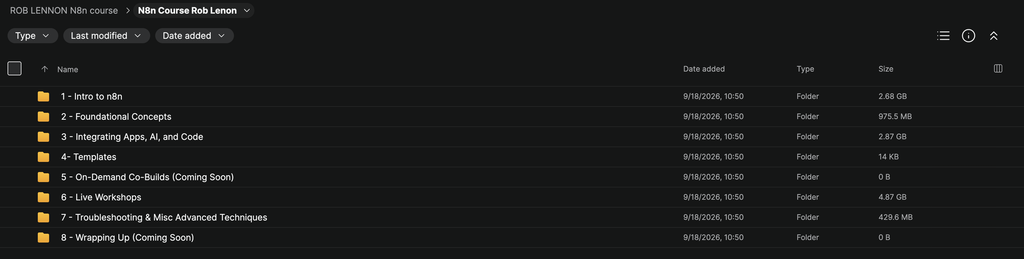
Rob Lennon – n8n Crash Course is a practical, implementation-focused training designed to help entrepreneurs, marketers, creators, operators, and automation professionals learn how to build powerful AI automations and workflows with n8n.
Instead of treating automation as a highly technical skill reserved for developers, the course breaks the process into understandable building blocks. You’ll learn how n8n works, how information moves between different applications, how to connect APIs, how to manipulate data, and how to turn repetitive business processes into workflows that can operate automatically.
Whether you’re completely new to n8n or already experimenting with automation, this course provides a structured path from understanding the fundamentals to creating more sophisticated workflows and integrations.
What Is the n8n Crash Course?
The course is built around one central objective:
Learn how to turn repetitive digital work into automated systems.
n8n provides a visual workflow environment where different applications, APIs, databases, AI models, and business tools can communicate with each other.
Rather than manually transferring information between tools or repeating the same administrative processes every day, you’ll learn how to create workflows where one event automatically triggers the next action.
For example:
Trigger → Collect Data → Process Information → Apply Logic → AI Processing → Take Action → Store Results
Understanding this workflow logic gives you a foundation that can be applied across marketing, sales, content, operations, customer support, research, and many other business processes.
What You’ll Learn
Throughout the Rob Lennon n8n Course, you’ll develop practical skills around:
- n8n fundamentals
- Workflow architecture
- Nodes and triggers
- Data handling
- Expressions and variables
- Conditional logic
- API integrations
- HTTP requests
- Webhooks
- Authentication
- Data transformation
- AI-powered workflows
- Application integrations
- Workflow debugging
- Error handling
- Automation design
- Workflow deployment
- Business process automation
The emphasis is on understanding how the different pieces work together so you can eventually design your own automations rather than depending entirely on pre-built templates.
n8n Foundations
The training begins by establishing the fundamentals required to work confidently inside n8n.
You’ll become familiar with the interface and understand how workflows are constructed from interconnected nodes.
You’ll learn the relationship between:
Triggers → Nodes → Data → Logic → Actions
This foundation is essential because sophisticated automations are ultimately combinations of these basic concepts.
Once you understand how information enters, moves through, and exits a workflow, building larger systems becomes significantly easier.
Building Your First Workflows
You’ll move from theory into practical workflow creation.
The course shows how to create workflows from scratch, configure individual nodes, connect applications, pass information between steps, and test executions.
You’ll learn how to think systematically about automation:
What starts the workflow?
What information does it need?
What should happen to that information?
Which conditions determine the next action?
Where should the final result go?
This approach helps you transform a manual process into a logical automation sequence.
Understanding Nodes and Triggers
Nodes are the individual building blocks of n8n.
You’ll learn how different node types perform different responsibilities within a workflow, including triggers, actions, transformations, conditions, and external integrations.
Triggers determine when an automation starts.
That could happen when:
- A form is submitted
- A webhook receives information
- A database changes
- A scheduled time arrives
- A new lead appears
- Another application sends data
- A specific event occurs
From there, additional nodes determine what happens next.
Data Transformation and Manipulation
Real-world applications rarely organize information in exactly the same format.
One platform might return a person’s full name while another requires separate first-name and last-name fields. Dates, arrays, objects, numbers, and text can also require transformation before being passed to another system.
The course teaches you how to work with the data moving through n8n and prepare it for subsequent workflow steps.
You’ll explore concepts such as:
- JSON data
- Fields and values
- Variables
- Expressions
- Filtering
- Mapping
- Formatting
- Arrays and objects
- Data extraction
- Data transformation
These skills become increasingly important as your workflows become more sophisticated.
Conditional Logic and Workflow Routing
Useful automations don’t always follow a single linear path.
Sometimes different information requires different actions.
You’ll learn how to introduce logic so your workflows can make decisions based on the data they receive.
For example:
Qualified Lead → Sales Workflow
Existing Customer → Customer Success Workflow
Unqualified Lead → Nurture Workflow
This allows you to create dynamic automations that respond differently depending on specific conditions.
API Integration
One of n8n’s most powerful capabilities is connecting services through APIs.
The course introduces the principles behind API integrations and shows how workflows can communicate with external applications even when a dedicated integration isn’t available.
You’ll explore concepts including:
- HTTP requests
- API endpoints
- API keys
- Authentication
- Parameters
- Headers
- Request bodies
- API responses
- Data extraction
Understanding these concepts dramatically expands what you can build with n8n.
Webhooks and Real-Time Automation
Webhooks allow applications to send information directly into an automation when something happens.
Instead of repeatedly checking another application for changes, a webhook can trigger your workflow immediately.
You’ll learn how webhook-driven workflows can be used to create faster and more responsive automation systems for forms, leads, customer activity, internal operations, and other business events.
AI-Powered Automation
Modern automation becomes considerably more powerful when traditional workflow logic is combined with artificial intelligence.
The course provides a foundation you can use to incorporate AI into automated processes.
Depending on your workflow and connected services, AI can potentially assist with tasks such as:
- Content processing
- Classification
- Summarization
- Information extraction
- Lead qualification
- Research organization
- Draft generation
- Customer request routing
- Data enrichment
- Structured information generation
The important skill is learning how to position AI inside a larger workflow rather than using it as an isolated chatbot.
Error Handling and Debugging
Building an automation is only part of the process.
Reliable workflows also need to handle situations where something goes wrong.
You’ll learn how to inspect workflow executions, identify where errors occur, understand the data passing through individual steps, and troubleshoot problems systematically.
This helps you move from simply creating automations to creating workflows that are easier to maintain and improve.
Real-World Business Automation
The principles taught throughout the course can be applied to many different business functions.
Potential use cases include:
Marketing Automation
Connect lead sources, organize prospect information, trigger follow-ups, process campaign data, and synchronize marketing tools.
Sales Automation
Move leads between systems, enrich prospect information, route opportunities, update CRMs, and automate repetitive sales administration.
Content Workflows
Create systems that collect ideas, organize research, process information with AI, prepare drafts, and move content between production tools.
Operations
Automate repetitive internal processes, notifications, database updates, reporting, and information transfers.
Customer Support
Route requests, classify incoming messages, synchronize customer information, and trigger appropriate follow-up processes.
From Simple Automations to Complete Systems
A major benefit of mastering n8n is that individual workflows can eventually become parts of larger automation systems.
Instead of creating one isolated automation, you can begin connecting multiple processes:
Lead Capture → Enrichment → Qualification → CRM → Follow-Up → Reporting
or:
Research → AI Processing → Content Creation → Review → Database → Distribution
This systems-based approach can help businesses reduce repetitive manual work while keeping humans responsible for decisions that require judgment.
Who Is This Course For?
Rob Lennon – n8n Crash Course is suitable for:
- Entrepreneurs
- Solopreneurs
- Digital marketers
- Agency owners
- Automation specialists
- AI enthusiasts
- Content creators
- Operations professionals
- Freelancers
- Consultants
- No-code builders
- Developers exploring workflow automation
- Business owners looking to automate repetitive processes
You don’t need to be an experienced programmer to begin learning the concepts.
However, understanding APIs, JSON, logic, and basic technical concepts will become increasingly useful as you progress toward advanced workflows.
Why Learn n8n?
Many businesses operate through dozens of disconnected applications.
Employees copy information from one platform to another, manually update spreadsheets, send repetitive notifications, organize incoming leads, and perform tasks that follow predictable rules.
Workflow automation allows many of these processes to be connected.
Learning n8n gives you the ability to look at repetitive work differently.
Instead of asking:
“How quickly can I complete this task?”
You can begin asking:
“Can I build a system that completes this task automatically?”
That shift is one of the most valuable concepts behind the course.
What Makes the Rob Lennon n8n Course Valuable?
The training focuses on practical implementation rather than automation theory alone.
By learning workflow architecture, data handling, APIs, conditional logic, debugging, and integrations together, you develop a skill set that can be transferred to many different automation projects.
More importantly, you’re learning the underlying logic behind automation.
Specific tools and AI models will continue changing, but concepts such as triggers, actions, APIs, structured data, conditions, webhooks, and workflow architecture remain fundamental.
Final Thoughts
Rob Lennon – n8n Crash Course provides a practical pathway into modern workflow automation for anyone who wants to connect applications, automate repetitive processes, and build more sophisticated digital systems.
From n8n fundamentals and workflow design to data manipulation, APIs, webhooks, conditional logic, AI integrations, debugging, and real-world business automation, the course provides the foundational knowledge needed to move beyond simple one-step automations.
For entrepreneurs, marketers, agencies, operators, and aspiring automation specialists, the training can serve as a strong foundation for understanding how to design and build workflows that save time and connect the tools used throughout a modern business.







Reviews
There are no reviews yet.