



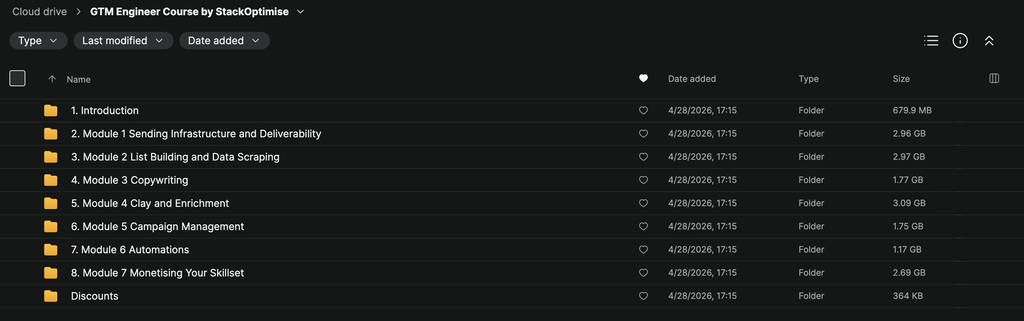
StackOptimise – GTM Engineer Course is a practical training program designed to help marketers, founders, operators, and automation professionals build modern Go-To-Market systems using AI, automation, data, and integrated sales technology.
Instead of treating marketing, sales, lead generation, CRM management, and automation as separate functions, the course focuses on the emerging role of the GTM Engineer — someone capable of connecting tools, data, workflows, and AI into one scalable revenue engine.
The program is built around implementation. You’ll learn how to design GTM infrastructure, automate repetitive sales and marketing processes, improve lead research and enrichment, build outbound systems, connect your technology stack, and create workflows that allow teams to operate faster with less manual work.
Whether you’re building systems for your own company, working inside a growth team, or offering GTM engineering as a service, this course provides a structured framework for turning disconnected tools into an efficient revenue operation.
What’s Included
Inside StackOptimise – GTM Engineer Course, you’ll explore the core systems behind modern AI-powered go-to-market operations, including:
- GTM engineering fundamentals
- Revenue infrastructure planning
- AI-powered sales workflows
- Lead generation and prospecting systems
- Data enrichment and management
- CRM architecture and automation
- Outbound campaign systems
- Workflow automation
- Sales and marketing integrations
- AI agents for GTM operations
- Reporting and optimization
- Practical implementation frameworks
- Repeatable systems for scaling GTM operations
The focus is not simply learning individual tools. The goal is understanding how the entire GTM technology stack works together.
StackOptimise GTM Engineer Course Breakdown
Module 1 – GTM Engineering Foundations
Start by understanding what GTM engineering actually means and why the role is becoming increasingly important across modern sales and marketing teams.
You’ll learn how traditional go-to-market operations are evolving as companies adopt AI, automation, enrichment platforms, CRMs, and specialized sales tools.
This foundation helps you understand how to think about:
- Revenue systems
- GTM architecture
- Sales operations
- Marketing operations
- Automation
- Data
- AI
- Tool integration
Instead of approaching every problem manually, you’ll begin thinking in terms of systems and repeatable workflows.
Module 2 – Building Your GTM Tech Stack
A powerful GTM operation depends on more than having dozens of software subscriptions.
The tools need to work together.
This section focuses on designing a technology stack where information can move efficiently between prospecting, enrichment, outreach, CRM, sales, and reporting systems.
You’ll learn how to think about:
Data Source → Enrichment → Qualification → Outreach → CRM → Follow-Up → Reporting
You’ll also develop a better understanding of where automation should be introduced and where human involvement still creates the most value.
Module 3 – Lead Generation & Prospecting Systems
Learn how modern GTM teams systematically identify potential customers rather than manually searching for prospects one by one.
This section explores workflows for building targeted prospect lists based on relevant company and customer characteristics.
You’ll learn how to structure prospecting around factors such as:
- Industry
- Company size
- Geography
- Job title
- Seniority
- Business characteristics
- Buying signals
- Qualification criteria
The objective is to build a repeatable prospecting engine that continuously supplies your sales process with relevant opportunities.
Module 4 – Data Enrichment & Qualification
Raw contact information isn’t enough for effective outbound campaigns.
GTM Engineers use enrichment workflows to transform basic records into useful sales intelligence.
You’ll learn how enrichment can help identify:
- Company information
- Decision makers
- Professional roles
- Contact information
- Business characteristics
- Relevant personalization data
- Qualification signals
You’ll also learn how to clean, organize, filter, and route data before it enters your outreach or CRM systems.
This helps create more targeted campaigns while reducing unnecessary manual research.
Module 5 – AI-Powered Personalization
Generic outbound messaging becomes increasingly difficult to differentiate.
This module explores how AI can assist with research and personalization at scale.
You’ll learn how to create workflows that combine prospect data with AI to generate contextual information that can support more relevant outreach.
Potential workflows include:
- Company research
- Prospect research
- Personalized opening lines
- Account summaries
- Lead qualification
- Message customization
- Sales research briefs
The objective isn’t simply generating more AI-written messages. It’s creating systems that give AI better context before generating anything.
Module 6 – Automated Outbound Systems
Once prospects have been sourced, enriched, and qualified, you’ll learn how to build the infrastructure required to move them into outbound campaigns.
This section explores the architecture behind scalable prospecting systems.
You’ll learn how to connect:
Lead Lists → Enrichment → Qualification → Personalization → Outreach → Response Handling → CRM
You’ll also explore how to build workflows that reduce repetitive administrative tasks while maintaining visibility into each prospect.
Module 7 – CRM Systems & Pipeline Automation
Your CRM should function as more than a database.
A properly designed CRM can become the central operating layer of your revenue system.
You’ll learn how to structure workflows around:
- New leads
- Qualified prospects
- Opportunities
- Follow-ups
- Pipeline stages
- Sales activity
- Customer information
- Deal status
Automation can then be used to update records, trigger actions, assign tasks, and keep information synchronized between different tools.
Module 8 – Workflow Automation
This section focuses on one of the core skills of a GTM Engineer: connecting systems together.
You’ll learn how to think about workflows using:
Trigger → Data → Logic → Action → Output
This framework can be applied across sales and marketing operations.
Examples include:
- Automatically enriching new leads
- Sending qualified prospects into campaigns
- Updating CRM records
- Routing leads
- Creating follow-up tasks
- Processing form submissions
- Generating prospect research
- Synchronizing information between platforms
Understanding workflow logic allows you to build systems that continue operating without constant manual intervention.
Module 9 – AI Agents for GTM
AI agents introduce another layer of automation by allowing systems to interpret information and perform multi-step processes.
This module explores how AI agents can support GTM operations.
Possible applications include:
- Prospect research
- Lead qualification
- Account analysis
- Sales preparation
- Content research
- CRM assistance
- Data processing
- Outreach preparation
You’ll learn to think beyond isolated prompts and toward AI systems connected to business data and workflows.
Module 10 – Building a Scalable GTM Engine
The final stage brings the individual components together into a complete system.
Instead of having separate tools for prospecting, enrichment, outreach, CRM, and AI, you’ll learn how to design an integrated GTM engine.
The overall architecture can look like:
Prospecting → Enrichment → Qualification → AI Research → Personalization → Outreach → Response → CRM → Follow-Up → Analytics
The result is a more structured revenue operation that can be monitored, improved, and expanded over time.
What You’ll Learn
By working through StackOptimise – GTM Engineer Course, you’ll develop practical knowledge around:
- Building modern GTM systems
- Understanding GTM engineering
- Designing sales technology stacks
- Automating lead generation processes
- Creating prospecting workflows
- Enriching and qualifying leads
- Using AI for sales research
- Building personalized outbound workflows
- Connecting sales and marketing tools
- Automating CRM operations
- Creating workflow logic
- Integrating AI into revenue operations
- Reducing repetitive GTM tasks
- Designing scalable revenue infrastructure
- Troubleshooting and optimizing automated systems
Build Systems Instead of Repetitive Tasks
A central idea behind GTM engineering is moving away from performing the same operational task repeatedly.
Instead, you build the system once and allow technology to handle much of the repeatable work.
For example, rather than manually researching every prospect, copying information into a spreadsheet, writing individual messages, updating the CRM, and creating follow-up reminders, a GTM Engineer can design workflows connecting those steps.
This changes the approach from:
Doing the work manually
to:
Building the system that performs the work.
That systems mindset is one of the most valuable skills covered throughout the program.
AI + Automation + Data + Sales
The course brings together four areas that increasingly overlap inside modern revenue teams:
AI helps process, research, classify, and generate information.
Automation moves information and triggers actions between systems.
Data provides the context needed for qualification and personalization.
Sales infrastructure turns those components into repeatable revenue processes.
Learning how these areas interact gives you a broader skill set than simply becoming proficient with one specific automation or sales tool.
Who Is This Course For?
StackOptimise – GTM Engineer Course is designed for people who want practical skills at the intersection of technology, sales, marketing, and automation.
It is particularly relevant for:
- GTM Engineers
- RevOps professionals
- Sales operations professionals
- Marketing operations specialists
- Growth marketers
- B2B founders
- Agency owners
- Automation specialists
- AI consultants
- Lead generation agencies
- SDR and outbound teams
- Freelancers building automation systems
- Entrepreneurs building scalable sales infrastructure
It can also be valuable for people transitioning from traditional marketing or sales roles toward more technical GTM positions.
Why the GTM Engineer Skill Set Matters
Modern companies often use many different platforms across their revenue operations.
The challenge is no longer simply finding another tool.
The challenge is making those tools work together.
A GTM Engineer sits between sales strategy and technical implementation, helping turn ideas into functional systems.
That can involve connecting databases, enrichment services, AI models, automation platforms, outreach tools, CRMs, and analytics systems into workflows that support the revenue team.
As AI capabilities continue expanding, understanding the underlying system becomes increasingly valuable.
Practical, Systems-Focused Learning
StackOptimise – GTM Engineer Course focuses on building operational skills rather than simply explaining GTM terminology.
The goal is to understand enough about data, automation, AI, and revenue operations to look at a manual process and ask:
Can this be turned into a reliable system?
That mindset can be applied to prospecting, research, qualification, outbound, CRM management, customer operations, reporting, and many other business processes.
Final Thoughts
StackOptimise – GTM Engineer Course provides a practical path for learning how modern revenue systems are designed, automated, and connected.
By combining GTM strategy, AI, workflow automation, prospecting, data enrichment, outbound systems, CRM architecture, and revenue operations, the program helps you develop the skills needed to build more efficient go-to-market infrastructure.
Instead of learning isolated tools, you’ll develop a systems-level understanding of how modern sales and marketing technology can work together — making the course especially relevant for anyone looking to build, manage, or offer AI-powered GTM systems.




Reviews
There are no reviews yet.